Neuro Scientia
  • Contact
  • Home
  • News
    • Entertainment
    • Trending
    • Intelligence
  • Neuroscience
    • Brain
      • Boost Brain
      • Brain plasticity
      • Brain Food
      • Brain Power
      • Brain health
      • Brain Science
    • Artificial intelligence
    • Behavioral Neuroscoence
    • Behaviour
    • Behavioural Science
  • Biology
    • Bio-Hacking
    • Brain Hacks
    • Brainology
    • Health
    • Body
  • Cognition
    • Cognitive Health
    • Cognitive neuroscience
    • Cognitive Psychology
    • Creativity
  • Genius
    • Genius IQ
    • Increase IQ
    • Intelligence Quotient
    • Intelligence Test
    • IQ
    • IQ Boost
  • General
    • Career
    • Business
    • Education
    • Healthcare
    • Ideas
    • Inspiration
No Result
View All Result
Neuro Scientia
  • Contact
  • Home
  • News
    • Entertainment
    • Trending
    • Intelligence
  • Neuroscience
    • Brain
      • Boost Brain
      • Brain plasticity
      • Brain Food
      • Brain Power
      • Brain health
      • Brain Science
    • Artificial intelligence
    • Behavioral Neuroscoence
    • Behaviour
    • Behavioural Science
  • Biology
    • Bio-Hacking
    • Brain Hacks
    • Brainology
    • Health
    • Body
  • Cognition
    • Cognitive Health
    • Cognitive neuroscience
    • Cognitive Psychology
    • Creativity
  • Genius
    • Genius IQ
    • Increase IQ
    • Intelligence Quotient
    • Intelligence Test
    • IQ
    • IQ Boost
  • General
    • Career
    • Business
    • Education
    • Healthcare
    • Ideas
    • Inspiration
No Result
View All Result
Neuro Scientia
No Result
View All Result

What Different IQ Scores Mean

neuroscientia by neuroscientia
February 11, 2018
in bad IQ, good IQ, high IQ, IQ, IQ of, IQ score, IQ score of.., IQ scores meaning, is this IQ good, Low IQ, what different IQ scores mean, what does an IQ mean, what is a good IQ
0
459
SHARES
2.7k
VIEWS
Share on FacebookShare on Twitter

Table of Contents

  • IQ Scores and Interpretations
    • Normal Distribution and IQ Scores 
    • Low IQ and Mental Retardation 
    • High IQ and Genius IQ 
    • Important IQ Scores
  • Can your IQ score change after some time? 

IQ Scores and Interpretations

What is a good IQ score? What is a high IQ score? What is a low IQ score? If you really care about your IQ, these are the common questions might have asked at one time or the other.

Even before the 20th century, Lewis Terman (1916) already built up the first idea of IQ and proposed this scale for grouping IQ scores:

More than 140 – Genius level IQ

120 – 140 – Very superior intelligence

110 – 119 – Superior intelligence

90 – 109 – Normal or normal intelligence

80 – 89 – Dullness

70 – 79 – Borderline deficiency

Under 70 – Mental retardation

Normal Distribution and IQ Scores 
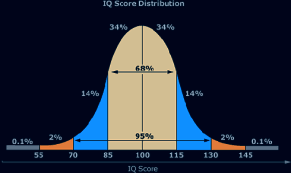
IQ scores
IQ scores

The normal distribution also applies to IQ scores:

50% of the world IQ scores fall in the range of 90 and 110

70% of IQ scores fall in the range of 85 and 115

95% of IQ scores fall in the range of 70 and 130

99.5% of IQ scores fall in the range of 60 and 140

Low IQ and Mental Retardation 

5% of individuals have an IQ under 70 and this is for the most part considered as the benchmark for “mental hindrance”, a state of restricted mental capacity in that it produces trouble in adjusting to the requests of life.

The severity of mental retardation can be broken into 4 levels:

50-70 – Mild mental retardation (85%)

35-50 – Moderate mental retardation (10%)

20-35 – Severe mental retardation (4%)

IQ < 20 – Profound mental retardation (1%)

High IQ and Genius IQ 

Genius IQ is for the most part considered to start around 140 to 145, This is ~.25% of the population (1 of every 400). Here’s a brief guide:

115-124 – Above normal

125-134 – Gifted

135-144 – Highly intelligent

145-154 – Genius

155-164 – Genius

165-179 – High genius

180-200 – Highest genius

>200 – “Unmeasurable genius”

More notes on High IQ and Genius IQ:

Mozart and Einstein’s IQ were estimated to be around 160.

Mensa is a general society for individuals with high IQ, 2% (1 of every 50) get into the Mensa IQ society with a qualifying IQ of 130.

Raw individual test scores are changed over with the goal that they connect flawlessly to a particular norm aligned with a specific population of same-age. The normal score is constantly 100.

Important IQ Scores

– An IQ score of 100 implies that half of the general population in your age aggregate scored better, and half scored more regrettable.

– An IQ score of 85 implies that 84.13% of the general population in your age aggregate scored better, and 15.87% scored more regrettable.

– An IQ score of 130 implies that 2.28% of the general population in your age aggregate scored better, and 97.72% scored more regrettable.

Can your IQ score change after some time? 

If your IQ scores can change after some time, for what reason do a great many people’s IQ scores remain sensibly stable?

What an individual can accomplish with the correct mix of benefits and moxie is altogether not quite the same as what a great many people really do accomplish.

The vast majority subside into a specific scholastic standing right on time throughout everyday life and don’t considerably digress from that standing. That is the latency of life and human situation.

So IQ scores don’t infer any kind of stableor intrinsic intelligence? 

An incredible opposite. We realize that the abilities IQ measures are aptitudes, and we realize that individuals can gain these abilities.

 Yes, IQ was originally designed to measure some sort of fixed attribute in our brain but it’s quite unfortunate that the IQ test is fundamentally flawed and only measures the aptitude of mainstream logic and the ability to take IQ tests.

 “Intelligence” Robert Sternberg (1985) has explained, “means to an arrangement of skills being developed.” There is a lot of proof, for instance, that tutoring raises general scholastic intelligence.

There is additionally prove that most individuals are not coming to their intellectual potential. Better schools can raise the level of learning for about all students.

References

  • Sternberg, R. J. (1985). Beyond IQ: A Triarchic Theory of Intelligence. Cambridge: Cambridge University Press.
  • The Measurement of Intelligence (1916)
Previous Post

How to Improve Memory Retention

Next Post

Advantages of Intelligence Testing in Staff Selection

Next Post

Advantages of Intelligence Testing in Staff Selection

About Us

Neuro Scientia

Thank you for visiting neuroscientia.com. This is open to all platforms to get knowledge about various topics. If you are bored then this website can help you to get rid of your boredom. We dont charge anything for that. Happy Reading :)

Hot Trends

The Business Benefits of a Fully Integrated SASE Solution

The Business Benefits of a Fully Integrated SASE Solution

by varsha
May 13, 2025
0

SASE (secure access service edge) is a cloud-based architecture that provides remote workers secure access to various applications and enables...

Strengthening Enterprise Security Against Modern DDoS Attacks with SASE

Strengthening Enterprise Security Against Modern DDoS Attacks with SASE

by varsha
April 15, 2025
0

Owning the tradition of DDoS attacks has evolved into a nightmare of never-ending threats in cyber environments. These outages, which...

How PPF (Paint Protection Film) Can Save You Money on Car Repairs

How PPF (Paint Protection Film) Can Save You Money on Car Repairs

by varsha
February 7, 2025
0

Car owners understand the importance of maintaining their vehicle’s appearance and performance, but few are aware of how a simple...

Most Recent

Why Skill-First Hiring Is Outperforming Traditional Recruitment Models
technology

Why Skill-First Hiring Is Outperforming Traditional Recruitment Models

August 1, 2025
  • About
  • Our Team
  • Advertise
  • Privacy Policy
  • Contact Us

Copyright © 2025 All Rights Reserved | Powered by Neuroscientia | GuestPost@GeniusUpdates.com

No Result
View All Result
  • Contact
  • Home
  • News
    • Entertainment
    • Trending
    • Intelligence
  • Neuroscience
    • Brain
      • Boost Brain
      • Brain plasticity
      • Brain Food
      • Brain Power
      • Brain health
      • Brain Science
    • Artificial intelligence
    • Behavioral Neuroscoence
    • Behaviour
    • Behavioural Science
  • Biology
    • Bio-Hacking
    • Brain Hacks
    • Brainology
    • Health
    • Body
  • Cognition
    • Cognitive Health
    • Cognitive neuroscience
    • Cognitive Psychology
    • Creativity
  • Genius
    • Genius IQ
    • Increase IQ
    • Intelligence Quotient
    • Intelligence Test
    • IQ
    • IQ Boost
  • General
    • Career
    • Business
    • Education
    • Healthcare
    • Ideas
    • Inspiration

Copyright © 2025 All Rights Reserved | Powered by Neuroscientia | GuestPost@GeniusUpdates.com